Florence is undergoing a phase of profound urban regeneration that is reshaping its face and housing dynamics. These are not marginal changes, but structural transformations that concretely alter property values and investment opportunities in entire neighborhoods.
Thoroughly understand the real estate market in Florence in 2026 means knowing how to seize unique opportunities by correctly interpreting infrastructural changes before the market has already fully priced them in.
For those who wish to invest today with a medium- to long-term vision, navigating this market requires a strategic approach that knows how to look beyond the historic center to burgeoning semi-central areas.
The evolution of real estate price trends in Florence
In 2026, thetrend of real estate prices in Florence shows solid values overall and a marked migration of investment to well-connected semicentral areas, a phenomenon that has become more pronounced in the past two years and looks set to consolidate.
Currently, the city scenario shows remarkable resilience. Average prices hover around 4,100-4,200 €/m² at the municipal level, with significantly higher peaks in the historic center (where they easily exceed 5,000 €/m² for properties in good condition) and more affordable prices in well-serviced suburban areas.
However, recent stringent regulations on short tourist rentals in the UNESCO historic center, with the blocking of new permits and increasingly tight controls, have changed investors’ strategies. Attention has shifted to semicentral areas with excellent amenities, those that still guarantee attractive revaluation margins and, above all, concrete possibilities of earning income through long-term residential leases.
This shift is changing price trends in favor of neighborhoods such as Novoli, Rifredi, Campo di Marte and the Careggi area, where rental demand is structurally sound due to the presence of universities, hospitals and business hubs. Trends that, moreover, are in line with the broader 2026 real estate market forecasts nationwide.
How urban regeneration and public greening drive home values
There is a direct correlation, now proven by numerous urban planning studies, between urban regeneration projects and the revaluation of affected neighborhoods.
In fact, the creation of new green areas, multipurpose public spaces and modern infrastructure not only results in a better quality of life perceived by residents, but also in measurably higher real estate prices and higher rental yields in the medium to long term.
Florence has well understood this dynamic and is investing heavily in the transformation of brownfield sites, the creation of new urban parks and the improvement of sustainable mobility. These are all interventions that attract young families, skilled professionals, and students-exactly the target that guarantees stability in the rental market and support for sales prices.
The case of Manifattura Tabacchi: a new attractive hub
Among the most important urban regeneration interventions, we cannot fail to mention Manifattura Tabacchi.
The completion of the massive redevelopment project of the Manifattura Tabacchi complex, strategically located between the Novoli and San Jacopino neighborhoods, is radically transforming the entire northwest quadrant of the city. This is not just a simple building redevelopment, but the creation of a true high-end residential, cultural and green hub.
The once run-down and inaccessible area is now home to exhibition spaces, fine residences, public green areas, and selected commercial activities. It has become a focal point for cultural events and new quality urban sociability.
And this buzz has physiologically pushed up property prices in the surrounding areas, creating excellent profit opportunities both for those who had the foresight to invest early in the area before the project was completed and for those who are about to do so.
For those looking ahead, the lesson is clear: identifying the next areas for urban regeneration means anticipating market revaluations.
The infrastructure effect: the impact of the tramway on house prices
In addition to urban regeneration, interventions made on infrastructure also have a real impact on house prices in Florence, and the data speak with unequivocal clarity.
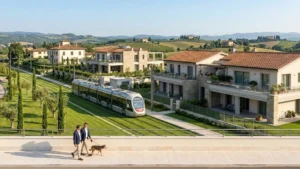
In fact, the proximity to tramway stops has historically driven up both purchase prices and rents, with measurable increases of between 10 percent and 15 percent compared to similar but less-serviced properties.
The reason is easily understood: the tramway quickly connects the suburbs to the heart of the city, drastically reducing dependence on the automobile in an urban setting where traffic and parking are problematic. For those who work downtown but want to live in a greener, more family-friendly neighborhood, proximity to a tramway stop becomes a determining factor in their choice of property.
As a result, properties served by the tramway are transformed into highly liquid and desirable assets: they sell faster, rent more easily, and hold their value better over time. The planned expansion of the network in the coming years to new parts of the city is thus a clear indication for forward-looking investors.
The best neighborhoods to invest in Florence today
Based on the analysis of current trends and planned infrastructure projects, the most promising neighborhoods to invest in Florence in 2026 are those that combine multiple favorable factors: extension of the tramway, new urban parks, and the presence of strategic hubs such as universities, hospitals, and business centers.
Here are the areas to focus on.
Novoli and Careggi: university hubs and top services
Real estate investment in Novoli is confirmed as one of the most rational and secure choices in 2026 for those seeking stable returns over the long term as the area benefits from a winning combination of factors that ensure structurally robust rental demand.
The proximity to the University Pole (with thousands of students seeking housing), theCareggi Hospital (which generates demand from doctors, residents, nurses, and researchers), and the Palace of Justice (with its induced supply of lawyers and administrative staff) creates a practically inexhaustible catchment area for those who own properties to rent.
Adding the excellent tramway coverage that connects Novoli and Careggi directly to the historic center and the Santa Maria Novella station within minutes, these areas are an absolute guarantee for those looking for a safe income property. Rents are sustained, vacancy (i.e., the period of vacancy) is minimal, and tenants tend to be reliable because they are tied to stable institutions.
The housing market in Campo di Marte: quality of life and green areas
The Campo di Marte real estate market is also experiencing a phase of great appreciation, supported by solid fundamentals that go beyond passing fads. This is a historic and stately area, traditionally beloved by Florentine families for its extraordinary wealth of amenities, urban parks and sports facilities.
The presence of Villa Fabbricotti Park, theCascine Nuove Hippodrome, the large Pettini-Burresi Park and numerous smaller green areas makes this neighborhood an oasis of livability just minutes from downtown. Schools are excellent, connections are excellent, and commercial services are abundant and diverse.
Quotations here are steadily rising because the quality of life is perceived as significantly higher than the city average, while remaining strategically adjacent to the historic center. In particular, families with children favor this area, and demand for three- and four-bedroom apartments with terraces or private gardens is always strong.
Rely on professionals for safe real estate investment
When it comes to investing tens or hundreds of thousands of euros in the real estate market, improvisation is the biggest risk one can take. The Florentine market is made up of micro-zones where values change significantly from one street to another, from one side of the street to another, from one floor of the same building to another.
Knowing these nuances requires firsthand experience, daily presence in the area, access to real sales data and not just the inflated asking prices of online ads. It requires the ability to assess not only the present, but also future urban planning projects, neighborhood demographics, and rental demand trends.
For financial decisions of this magnitude, it is essential to rely on experienced real estate agents who live and breathe the territory on a daily basis and know exactly where the opportunities and where the risks lurk.
The Florence office of Idee&Immobili offers tailor-made real estate services to guide you step by step through every stage of your investment: from finding the right property to an accurate price evaluation, from checking urban planning documentation to managing the lease. Protecting your capital and ensuring the highest possible return in safety.
Frequently asked questions about real estate investment in Florence
What is the trend of real estate prices in Florence in 2026?
Average city prices remain solid around €4,100-4,200/m², with marked growth in semicentral areas affected by urban redevelopment projects and well served by the tramway. The historic center maintains higher prices but with less dynamism.
Is it worth buying a house in Novoli for investment use?
Absolutely. The presence of the University Pole, the Court and the Careggi Hospital guarantees constant and structural rental demand. Properties rent quickly and generate a secure income with sustained rents and reliable tenants.
How is the tramway affecting real estate prices in Florence?
Proximity to bus stops raises purchase prices by 10-15% and sustains rents, making properties more liquid (they sell/rent faster) and drastically lowering connection times to downtown, reducing dependence on the car.
What are the advantages of investing in the Campo di Marte neighborhood today?
You invest in an area with very high quality of life, large green spaces, excellent school and commercial services. These elements ensure constant appreciation over time and attract stable families, reducing rental turnover and increasing the security of investment.
What impact does the redevelopment of the Manifattura Tabacchi have on the Florentine market?
It is transforming the entire northwest quadrant into a new cultural and residential hub of value, with green spaces and modern amenities. This has pushed up the prices of the entire neighboring neighborhood (San Jacopino, Porta al Prato) creating opportunities for early investors.
Where is it worth buying a house in Florence to put it into income?
In semicentral areas well served by the tramway and close to strategic hubs: Novoli and Rifredi (for students and professionals), Careggi (for hospital staff), Campo di Marte (for families). These areas guarantee high and constant rental demand with minimal vacancy.